AISG Research Collaborative Project with US-NSF Researchers

Ensuring that AI systems are trustworthy and reliable is crucial for advancing artificial intelligence capabilities and maintaining technological competitiveness. Cutting-edge research in this area aims to build systems that are not only safe and robust, but also transparent and explainable, contributing to AI innovation leadership and advancing capabilities that benefit both collaborating nations.
In recent years, intelligent human-AI collaboration systems such as ChatGPT have transformed how we approach complex optimization tasks. These systems enable humans to delegate intricate decision-making to AI while retaining the ability to guide and steer the problem-solving process through natural language feedback. As such systems become more integrated into critical applications, it is essential to ensure their alignment with operational requirements and to advance the theoretical foundations that will strengthen both nations’ positions in global AI competition through collaborative research excellence.
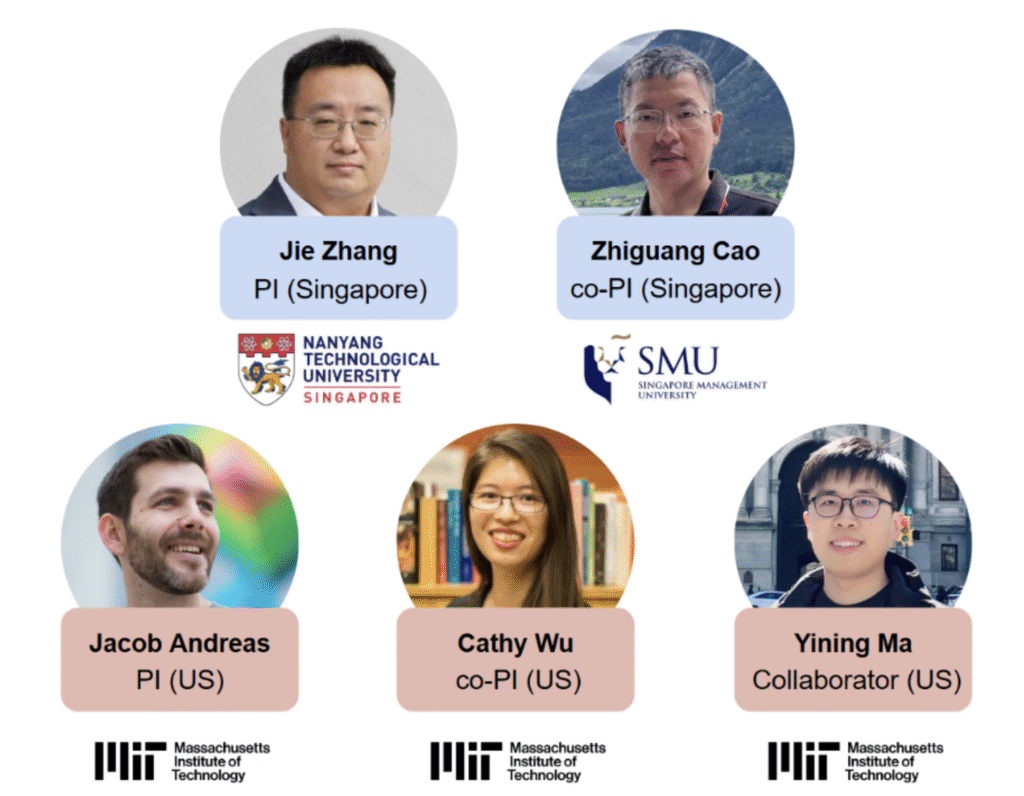
Singapore Team
- Principal Investigator: Professor Jie ZHANG (Nanyang Technological University)
- Co-Principal Investigator: Assistant Professor Zhiguang CAO (Singapore Management
University)
US Team
- Principal Investigator: Associate Professor Jacob ANDREAS (Massachusetts Institute of
Technology) - Co-Principal Investigator: Associate Professor Cathy WU (Massachusetts Institute of
Technology) - Collaborator: Postdoctoral Associate Yining MA (Massachusetts Institute of Technology)
Research Problem
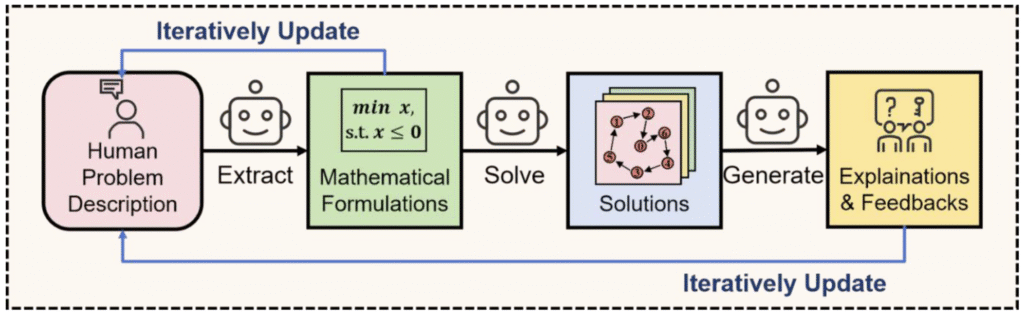
A major limitation of current human-AI collaboration systems is their ability to handle complex decision-making problems that involve combinatorial optimisation. In this context, this project aims to establish natural language as a robust interface for trustworthy AI-human interactive optimisation, ensuring that human-AI collaboration is robust, trustworthy, and practically deployable. This involves ensuring that the AI system
- Formulates combinatorial optimisation problems from the imprecise, ambiguous, error-prone, or overly ambitious natural human language.
- Ensures robust AI-assisted optimisation, effectively handling the generated optimisation instances across diverse conditions.
- Returns explainable language feedback to users that explains decision-making results and rationale to enhance transparency and foster trust.
Proposed Approach
To formulate combinatorial optimisation problems from imprecise, ambiguous, error-prone, or overly ambitious natural human language, the framework first assesses whether the user input can be feasibly translated into a combinatorial optimisation problem formulation using auto formalisation techniques, iterating with the user to identify potentially missing or conflicting information. The formulated problem is validated for correctness using a voting mechanism and automatic unit testing.
To ensure robust AI-assisted optimization, a foundation model with unified representation learning that systematically encodes combinatorial optimisation problem instances will be developed, ensuring consistency and adaptability across diverse problem settings. A novel adaptive solver selection framework that integrates multiple solving algorithms will also be developed and paired with a dynamic algorithm selection method that adaptively chooses the most suitable solver for a given problem instance.
To return explainable language feedback to users that explains decision-making results and rationale to enhance transparency and foster trust, the internal representations of neural combinatorial optimisation models will be analysed using systematic probing techniques. The decision concepts embedded in deep neural combinatorial optimisation models will also be studied using a concept-based interpretability approach that leverages higher-level abstractions more aligned with human reasoning.
Project Outcomes
This project will develop robust, trustworthy, and interpretable AI-assisted optimisation tools, enabling industries such as logistics, manufacturing, and finance to solve complex problems more efficiently, reducing costs, enhancing productivity, and minimising resource consumption. Additionally, it will support personal planning applications, such as intelligent calendar assistants, empowering individuals to manage tasks more effectively. In the long term, this research will establish the foundation for chat-based human-AI collaboration systems, advancing trustworthiness, robustness, and explainability to foster more general AI adoption and enable smarter, more trustworthy AI decision-making and planning.